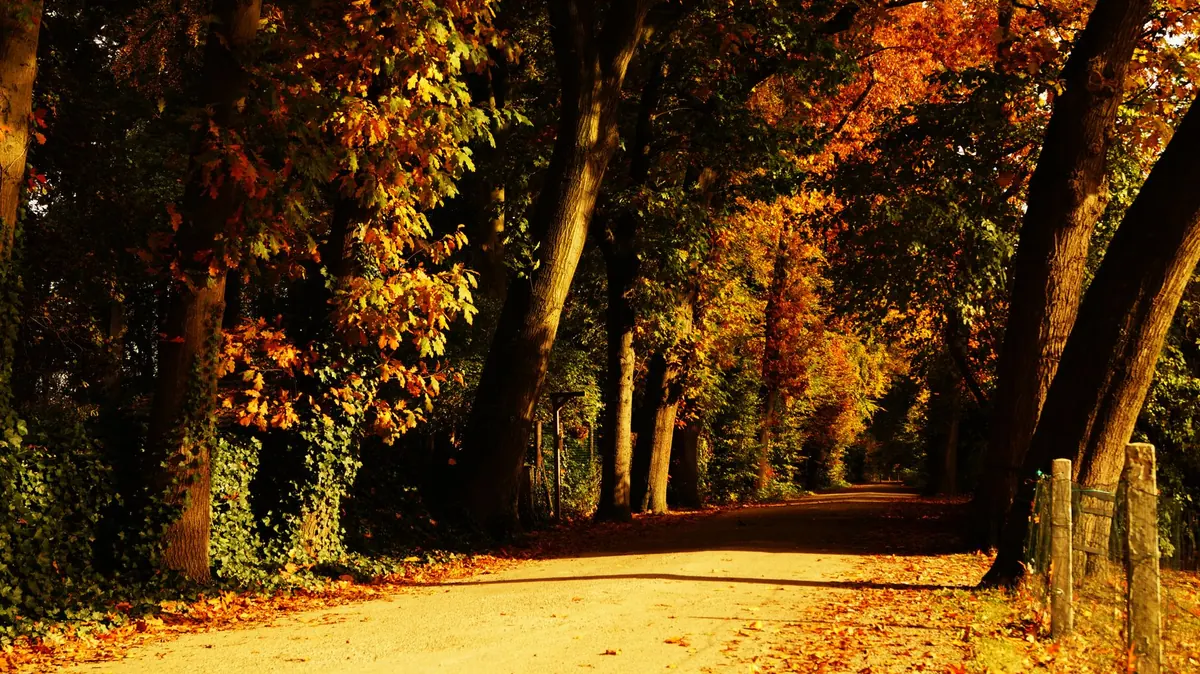
Autumn suits the Yorkshire Dales better than any other season. The crowds thin after the school holidays, the light goes long and low, and the ash, oak and rowan start turning across the limestone. These five drives are short — most can be done in half a day — and each comes with a quieter alternative to the obvious tourist route. Take them slowly. This is sheep country, and the best bits are often the single-track lanes where you have to pull into a passing place anyway.
When the colour comes
Peak autumn in the Dales rarely lands on one neat weekend. Height decides the timing. Rowan, birch and the small hawthorns on the high moors turn first, often in the first half of October; the ash, oak and sycamore on the valley floors hold out until early November. Larch — the one conifer that joins in — goes gold last of all.
A simple rule: drive high early and low late. A still, bright October after a wet September usually gives the best show, and a single windy day can strip a hillside bare. If you have only one day free, aim for mid to late October and start with the highest road on your list.
1. Coverdale and Park Rash: Wensleydale's quiet twin
Running parallel to Wensleydale, Coverdale is what its famous neighbour looked like before the coaches arrived. Start at Middleham, turn off at East Witton, and follow the lane past Coverham Abbey to Carlton and Horsehouse, where the valley narrows into something far wilder than Wensleydale ever manages.
From Horsehouse the road climbs Park Rash, a genuinely steep set of hairpins with tight bends and a gradient that will test a loaded car. In dry weather it is fine. In wet leaves or the first frost, treat it with respect — or simply turn around at Horsehouse, because most of the colour is below you anyway. Drop down to Kettlewell for lunch, then return through Wharfedale and back over to Leyburn. The view down Coverdale from the top of the pass is the reason to come.
2. Dentdale and the Coal Road
Dentdale gets skipped, which is exactly why it works in autumn. Come in from Sedbergh — the A683 is fast and empty — then slow right down for the descent into Dent village, a huddle of cobbled lanes and grey stone that looks its best against turning trees.
From Dent, follow the lane through Gawthrop and Cowgill towards Dent Head and Newby Head, where the road meets the Hawes to Ingleton route. For the quieter version, take the Coal Road from Garsdale Station over to Dent. It is single-track, unfenced in places, with gates to open and close and wide views across to Baugh Fell. It is not a road to rush, and it beats queueing for a parking space at Ribblehead by a comfortable margin.
3. Arkengarthdale and Tan Hill
Reeth is busy in July and peaceful by October. Head north up Arkengarthdale through Langthwaite and Booze — a proper Dales village name — to Tan Hill, the highest pub in England and a natural stopping point. The climb out of the dale is bare, high and exposed, so the colour here comes from scattered rowans and rusting bracken rather than woodland.
From Tan Hill you can drop down to Keld and return through Swaledale via Muker, or double back through Arkengarthdale and take the Buttertubs road south. Both work. The Keld route is steeper and narrower, with a couple of sharp hairpins, so leave it for a dry day. Pick a clear afternoon if you can: the sun drops behind the western fells and the whole dale goes copper.
4. Littondale: the quiet way to Malham
Everyone drives to Malham in October. Littondale, one valley over, serves up the same limestone scenery without the car park scrum. Take the B6160 from Grassington, turn at Kilnsey — the crag is worth a stop on its own — and follow the lane to Arncliffe, Litton and on to Halton Gill.
The road effectively ends at Foxup, so this is an out-and-back drive rather than a loop. That is a feature, not a fault: you see the same valley twice, in two different lights. Park in Arncliffe, walk twenty minutes up the beck, and you will have the place more or less to yourself.
Practically, there is one village pub and no fuel in the dale. Fill up in Grassington and carry cash for the honesty boxes that appear on farm verges at this time of year.
5. Mallerstang and the upper Eden
The far north-east corner of the national park sees almost no visitors, which is the entire appeal. From Kirkby Stephen — fuel, shops, decent coffee — take the B6259 north-west into Mallerstang, with Wild Boar Fell on one side and the River Eden running alongside the road.
Pendragon Castle sits right beside the tarmac, a ruin in a field with no ticket office and no queue. Continue to Outhgill and on towards Garsdale, then climb over to Hawes if you have the time, or turn back and take the lane towards Nateby. Mallerstang is high, open and windswept, so the autumn show here is bracken, heather and the last of the rowan rather than woodland. On a bright, still day it is one of the best drives in the Dales.
Practical notes before you set off
- Fuel first. Petrol is scarce in the dales. Fill up in Leyburn, Hawes, Sedbergh, Kirkby Stephen or Grassington before you commit to a loop.
- Check before you go. High routes such as the Coal Road, Park Rash and the Tan Hill to Keld road can be affected by surface damage, closures or snow gates after a storm. A quick look at the county council road pages and a local forecast saves a wasted trip.
- Drive the lanes properly. Single-track roads with passing places are the norm here. Pull in for oncoming traffic and for anything faster behind you, and never park in a passing place.
- Expect livestock and game. Sheep graze unfenced moorland and have no road sense. Pheasants and red grouse appear without warning, and deer move at dusk.
- Watch the surface. Wet leaves on tarmac, mud dragged from field gates and low sun over a wet road are the three things most likely to catch you out.
- Carry layers and boots. Valley sunshine can turn into a cold, wet moorland wind within a few miles and a few hundred feet of climbing.
- Park considerately. Village verges are working spaces. Use designated car parks or marked bays, and leave gates as you find them.
Two last things. Offline maps are worth having, because signal comes and goes in the dales, and no drive here is worth spoiling the road for the people who live along it. Go early, go slow, and stop often — the colour lasts about three weeks, and the quiet lanes are the ones you will remember.
Photo: George Becker / Pexels