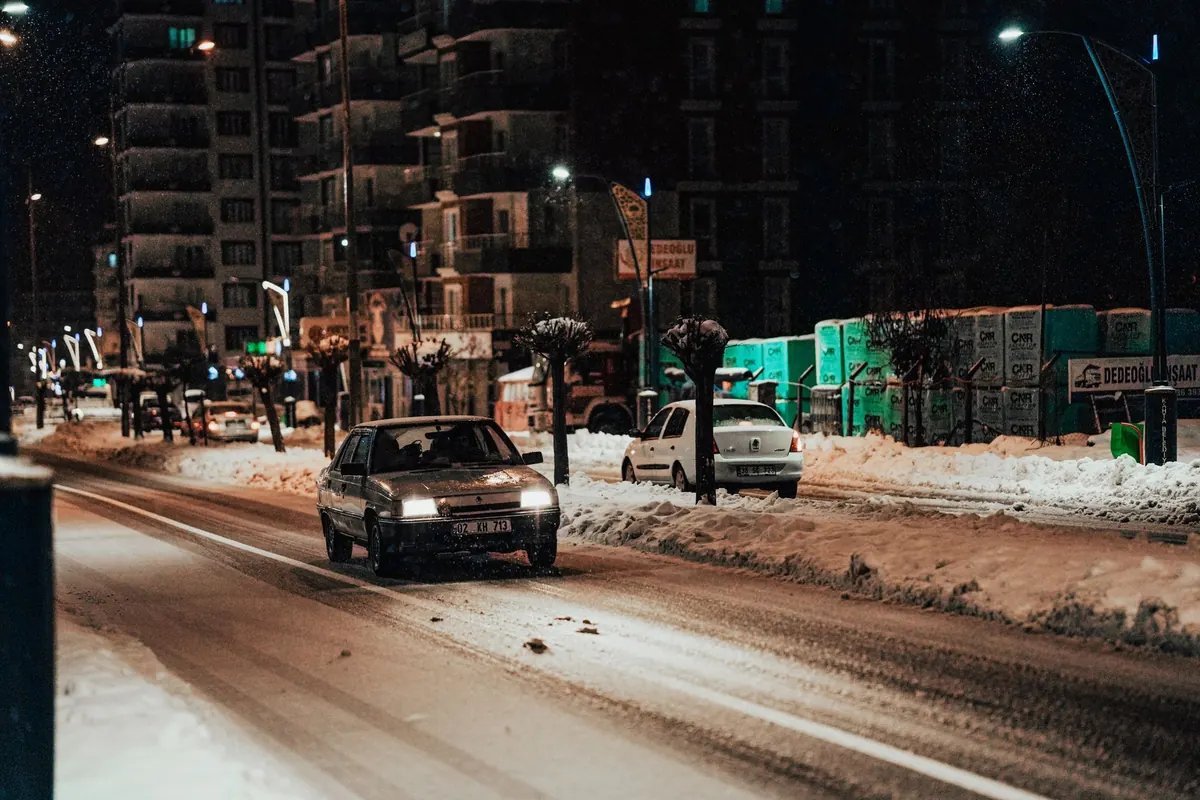
There is a particular kind of Pennine morning where the valley is clear, the tops are white and the forecast uses the word "persistent" more than once. The A57 over Snake Pass has its gates closed, the M62 is down to a crawl on the high stretch past junction 22, and somewhere on the A628 a hatchback sits at a strange angle with a spinning front wheel and a driver discovering what a summer tyre does at minus four.
None of that is bad luck. It is preparation, or the lack of it. Ten minutes of checking before you leave, plus a modest bag of kit that lives in the boot from November to March, will get you through almost anything these roads can produce.
Before You Turn the Key
Glass first. Clear the whole windscreen, not a porthole, and do the side windows too — a Pennine junction arrives quickly and you need the full view. Brush the snow off the roof as well. It slides forward under braking, and it does not care that you were in a hurry.
Then the lights, mirrors and number plates. Snow packed over a lamp makes you nearly invisible in spray, and it is a job you can finish with a gloved hand in a layby.
Two things catch people out on high routes. The first is fuel. Keep at least half a tank between November and March. A closed road, a twenty-mile diversion across the valley and an hour idling for warmth all burn the same expensive stuff, and the filling station you were counting on may be thirty miles behind you. The second is information. Check the forecast and the live road picture before you commit, and know which of your options closes first: the A66 across Stainmore, the A628, the A57, the A686 over Hartside and the Kirkstone Pass all shut or restrict vehicles in poor conditions, and exposed sections hold high-sided vehicles back at short notice.
Decide now where you would rather turn around. That decision is much easier made in a warm kitchen than at a snow gate with a queue behind you.
The Twelve Things Worth Their Boot Space
You don't need expedition kit. You need twelve items that each solve one specific problem.
- An ice scraper and de-icer. A proper plastic scraper, not a bank card. Spray for the screen and a separate can for the door seals, which freeze solid.
- A soft snow brush. Cheaper than a paint repair, and quicker than a scraper for a full car.
- Warm layers you would genuinely wear outside. Coat, hat, gloves and boots. If you drive in thin shoes, put the boots in the boot.
- A blanket or old sleeping bag. One per passenger is ideal. Its job is to make waiting two hours survivable rather than miserable.
- A torch, preferably a head torch, with spare batteries. Hands-free light makes changing a wheel at dusk far less grim.
- A high-visibility vest for every occupant. A dark coat on a dark verge is an invitation nobody wants.
- A compact shovel and a bag of grit. Cat litter works too. Digging out and a handful of traction under the driven wheels has rescued more cars than any gadget.
- Jump leads or a charged jump pack. Cold mornings finish off tired batteries, and you will either need them or be able to lend them.
- A phone charger and a power bank. Your phone is your map, your torch and your call for help. Treat it as vehicle equipment, not a personal one.
- Food and a flask. Something that needs no heating, and a hot drink in a vacuum flask. A bottle of water left in the car will freeze and split.
- A rated tow strap or recovery rope. Only use it if you know your towing eye, its location and how to attach it safely. A strap under tension stores real energy, so keep everyone clear of the line and never use rope that isn't rated for recovery.
- A basic first aid kit, plus any medication you may need. If you take prescription medicine or have a condition affected by cold, speak to your GP or pharmacist about what to carry on long winter journeys.
A warning triangle and a spare bulb kit are useful additions on ordinary roads. Don't place a triangle on a motorway, where walking in live lanes is far more dangerous than the breakdown itself.
Tyres, Battery and Other Cold-Weather Checks
Tyres
The legal minimum tread for a car is 1.6mm, but that figure is about water, not snow. For winter running, most drivers replace well before it — around 3mm is a sensible line in the sand for a tyre expected to shift slush and grip frost. Check across the width of the tyre and at a few points around the circumference, because shoulders wear faster than centres and a tyre can be legal in one place and not another.
Pressures fall as the temperature drops, so a set that was perfect in September will look soft by December. Check them cold, to the figures on the door pillar or in the handbook. Don't over-inflate hoping for grip; it reduces the contact patch and makes things worse.
If you do a lot of early starts over the tops, all-season tyres marked with the three-peak mountain snowflake symbol are worth considering. They stay softer and grippier than summer rubber below about seven degrees, and they mean one set of wheels instead of two. Check the spare too, along with the jack and the wheel brace — the day you need them is not the day to find out the brace doesn't fit.
Under the Bonnet and Behind the Glass
Have the battery tested before the first hard frost, top up the screenwash to a winter concentration, check the antifreeze strength and replace tired wiper blades. None of this is expensive. All of it fails on the morning you least want it to.
Driving Snow, Ice and Hill Fog
In snow
Pull away in second if you can, keep the revs low and the inputs gentle. On a climb, momentum is your friend: don't stop halfway up if there is any way to keep rolling. On a descent, choose a low gear early and let the engine hold you back rather than relying on the brakes. Leave several times the gap you would normally use, and switch the cruise control off — it has no idea the surface has changed.
On ice
Suspect it in the usual places: shaded cuttings, bridge decks, cattle-grid approaches and the bottom of dips where water collects and refreezes. At low speed on a clear straight you can test gently with a light brake, but never brake and steer at the same time. If the car slides, ease off and look where you want to go, not at the thing you are trying to miss.
In fog
Use dipped headlights and fog lamps when visibility is seriously reduced, and switch the fog lamps off as soon as it lifts — they dazzle other drivers and are only intended for those conditions. The classic mistake is to follow the tail lights ahead far too closely. Use the nearside verge and the centre line to hold your position, and expect a slow tractor, cyclist or stationary vehicle around the next bend. On the tops, add wind to the list: sudden gusts at summit cuts move cars and can catch high-sided vehicles badly.
Steep, shaded and exposed: the three words that should make you check a Pennine route twice before you drive it.
If You Get Stuck or Stopped
Get the car as far off the running line as you safely can, hazards on, and stay with it unless a lit building is genuinely within easy reach. Before running the engine for warmth, clear snow from the exhaust and never do it in an enclosed space — carbon monoxide kills quietly. Run it in short bursts with a window slightly open, and put your warm layers on before you feel cold. Staying warm is far easier than getting warm.
If you are stuck in snow, shovel around the wheels, spread grit or litter in front of the driven tyres, straighten the steering and rock the car gently between first and reverse. Spinning the wheels only polishes the snow into ice and can wreck a tyre. Don't walk to find help on an unlit high route in ordinary shoes; a phone call with an exact location beats a walk along a road with traffic on it.
A Short Routine Worth Keeping
Give the car an hour in late autumn: battery, tyres, screenwash, wipers, brake and steering condition checked by a garage, and the boot bag packed. Then check pressures once a month, top up the screenwash, and go through the bag — the torch batteries and the chocolate vanish on their own. Do that, and a Pennine winter becomes weather you drive through, rather than an emergency you survive.
Photo: SERHAT TUĞ / Pexels